28 Hand Embroidery Stitches Every Beginner Should Know
A visual guide to 28 hand embroidery stitches: lines, fills, knots, flowers and borders, with what each stitch is for and which to learn first.
By Ayoub Farid · · 3 min read
There are hundreds of embroidery stitches, but you don't need hundreds. These 28 cover almost every beginner and intermediate pattern you'll find. They're grouped by what they do, with a link to a full step-by-step guide for each one. If you're brand new, learn them in the order of the first section and you'll be able to stitch most simple designs within a couple of weeks.
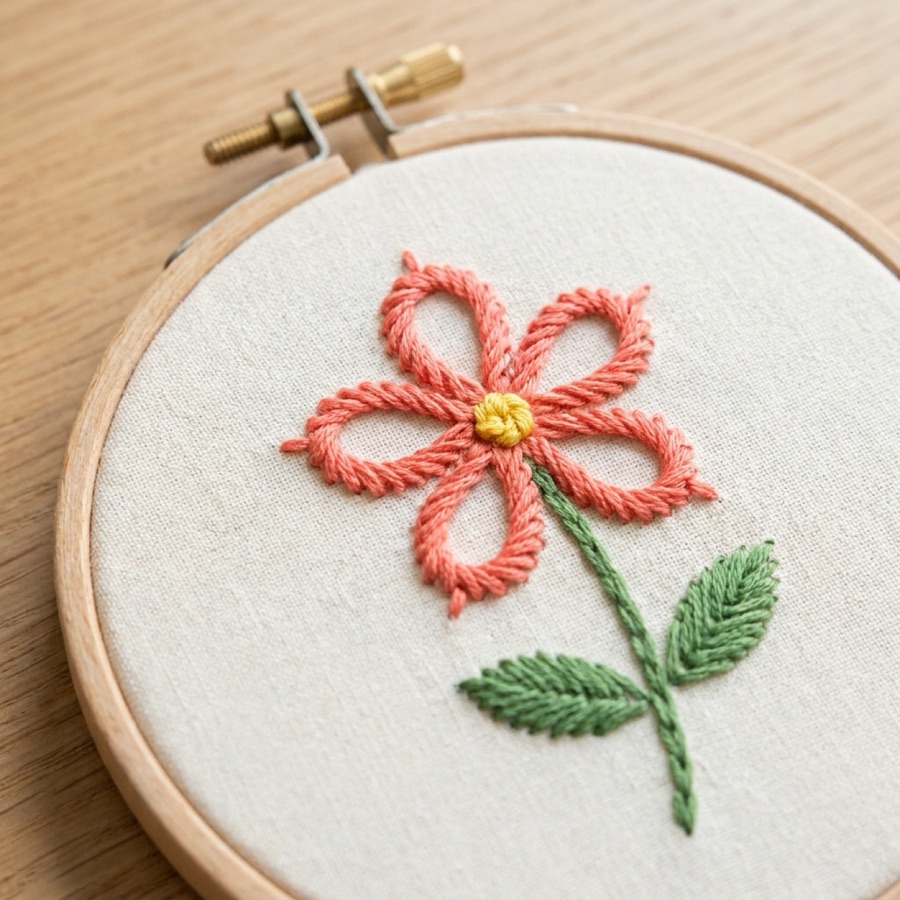
Start here: the first 8 stitches
If you only learn eight stitches, learn these, in this order:
- Running stitch: dashed lines, your first rhythm.
- Back stitch: solid outlines and lettering.
- Stem stitch: smooth curves and stems.
- Split stitch: letters and satin outlines.
- French knot: dots and flower centres.
- Satin stitch: smooth, glossy fills.
- Lazy daisy: petals and leaves.
- Chain stitch: bold outlines.
This is close to the order Hoopie's 4-week plan follows.
Line stitches
| Stitch | Best for |
|---|---|
| Running stitch | Dashed lines, sashiko, quilting |
| Back stitch | Outlines, lettering, details |
| Stem stitch | Curves, stems, vines |
| Split stitch | Letters, outlines under satin |
| Straight stitch | Rays, grass, fur |
| Chain stitch | Bold outlines, script |
| Twisted chain stitch | Rope-like lines |
| Whipped back stitch | Smooth, raised outlines |
| Couching | Thick or metallic threads |
Fill stitches
| Stitch | Best for |
|---|---|
| Satin stitch | Small smooth shapes |
| Long and short stitch | Large shapes, shading |
| Seed stitch | Easy texture, light shading |
| Turkey work | Fluffy pile |
| Trellis couching | Lattice fills |
Knots
| Stitch | Best for |
|---|---|
| French knot | Dots, centres, texture |
| Colonial knot | Firm, taller dots |
| Bullion knot | Coils, raised petals, roses |
| Pistil stitch | Stamens, fireworks |
Flowers and leaves
| Stitch | Best for |
|---|---|
| Lazy daisy | Petals, leaves |
| Woven wheel rose | Puffy roses |
| Ribbed spider wheel | Textured roses, webs |
| Fishbone stitch | Leaves with a vein |
| Fly stitch | Ferns, wheat |
| Fern stitch | Fronds, sprigs |
Borders
| Stitch | Best for |
|---|---|
| Blanket stitch | Edges, felt, appliqué |
| Cross stitch | Borders, folk motifs |
| Herringbone stitch | Bands, hems |
| Feather stitch | Vines, crazy quilt seams |
How to practise them
Make a stitch sampler: a hoop with one short row of each stitch, labelled with a washable pen. It becomes your personal reference. See embroidery sampler ideas for layouts.
When you practise, focus on one quality at a time: even length, then smooth curves, then tension. That's exactly what Hoopie's photo coach checks: after each stitch, you photograph your hoop and get a score with up to two specific fixes. If something looks off, the common embroidery mistakes guide explains why.
Frequently asked questions
What is the easiest embroidery stitch?
Running stitch, followed closely by straight stitch and back stitch.
How many embroidery stitches do I need to know?
Five to eight stitches cover most beginner patterns: running, back, stem, French knot, satin, lazy daisy, split and chain.
What order should I learn embroidery stitches in?
Lines first (running, back, stem, split), then knots and fills (French knot, satin), then flowers (lazy daisy, woven wheel rose).
What is the most versatile embroidery stitch?
Back stitch: it handles outlines, lettering and details, and it's the base for whipped back stitch.