Bullion Knot: How to Make Neat Coils and Bullion Roses
Step-by-step bullion knot tutorial: how many wraps, the right needle, keeping coils even, and how to arrange bullion knots into roses and petals.
By Ayoub Farid · · 3 min read
A bullion knot is a long, coiled knot that sits on the fabric like a little caterpillar. On its own it makes raised petals, leaves and textured lines. Arranged in a spiral, it makes a classic bullion rose. It takes a few attempts, but once the motion clicks, it becomes a favourite.
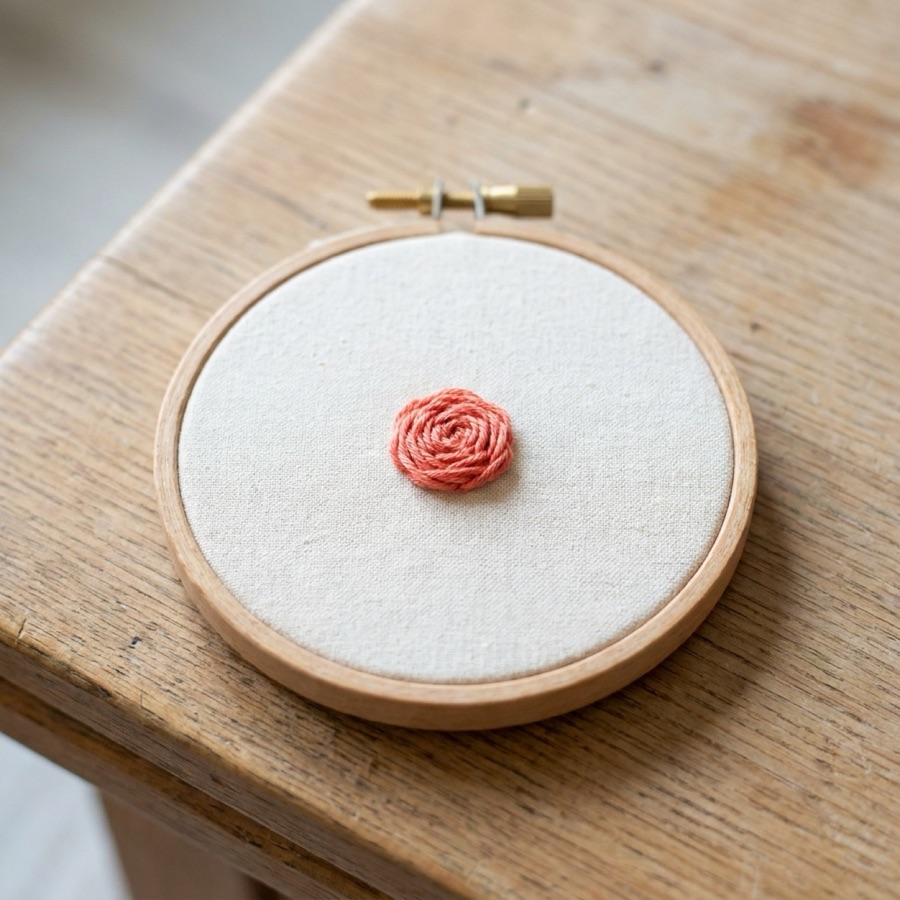
What you need
- A milliner's (straw) needle. This matters more for bullions than any other stitch: the eye is no wider than the shaft, so the wraps slide off easily.
- 2–3 strands of floss
- Drum-tight fabric
How to make a bullion knot, step by step
- Come up at point A, one end of the knot.
- Go down at point B, the other end (the length of your knot), and come back up at A without pulling the needle all the way through. Leave the needle sitting in the fabric with its tip out at A.
- Wrap the working thread around the needle tip, close to the fabric, until the wraps cover the distance from A to B (plus one or two wraps extra).
- Hold the wraps gently between your thumb and finger.
- Pull the needle through the wraps while holding them, then pull the thread toward B until the coil lies flat.
- Go down at B to anchor the knot.
Tips for neat bullions
- Wrap evenly and snugly, not tightly; tight wraps won't let the needle pass.
- Count wraps. For a 6 mm knot with 2 strands, about 8–10 wraps is typical. Note what works and repeat it.
- Smooth the coil by stroking it with the needle before you anchor it.
- A slightly longer coil than A–B makes a curved knot, which is perfect for rose petals.
Common mistakes
| Problem | Cause | Fix |
|---|---|---|
| Needle won't pull through | Wraps too tight or eye too thick | Wrap more loosely, use a milliner's needle |
| Messy, uneven coil | Wraps crossing over each other | Wrap in one direction, keep wraps side by side |
| Gap between coil and fabric | Too few wraps for the A–B distance | Add wraps |
| Knot unravels | Not anchored at B | Go down at B right after pulling through |
Making a bullion rose
- Make two short bullion knots side by side for the centre in a dark shade.
- Add 3–4 curved bullions around them in a medium shade, each overlapping the last.
- Finish with 5–6 longer curved bullions in a light shade.
Add lazy daisy leaves for a finished look. For an easier rose, start with the woven wheel rose, and see how to embroider a rose for both techniques side by side.
Frequently asked questions
Why won't my bullion knot pull through?
The wraps are too tight or the needle's eye is wider than the shaft. Wrap a little more loosely and use a milliner's needle.
How many wraps for a bullion knot?
Enough to cover the distance between the two points, plus one or two. The number depends on thread thickness and knot length.
What is a bullion knot used for?
Roses, raised petals, leaves, little caterpillars and textured lines.
What is the difference between a bullion knot and a French knot?
A French knot uses 1–2 wraps and makes a dot. A bullion knot uses many wraps laid along the fabric to make a long coil.