French Knot: How to Make Neat Knots Every Time
How to make a French knot step by step, how many wraps to use, and why knots pull through or come out loose, with simple fixes for each problem.
By Ayoub Farid · · 3 min read
French knots are tiny raised dots of thread, perfect for flower centres, eyes, berries, polka dots and texture. They have a reputation for being tricky, but almost every problem comes down to one of two things: where you put the needle back down, and how you hold the thread while you pull through.
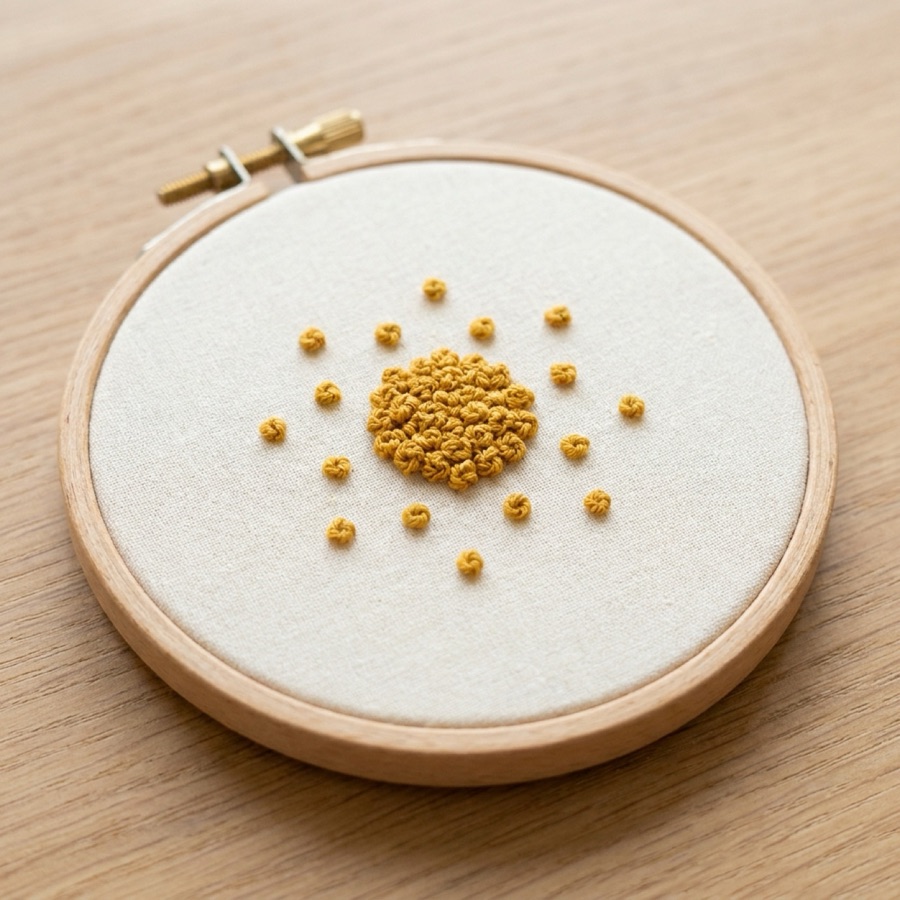
How to make a French knot, step by step
- Come up where you want the knot (point 1).
- Hold the working thread taut with your non-needle hand, a few centimetres from the fabric.
- Lay the needle against the thread and wrap the thread around it once or twice, close to the tip.
- Insert the needle very close to point 1, about one or two fabric threads away. Not in the same hole.
- Keep holding the thread taut so the wraps slide down snugly against the fabric.
- Pull the needle through to the back slowly, still holding the tension until the last moment.
That's it: a round knot sitting on the surface.
How many wraps?
Use one or two wraps. For a bigger knot, use more strands of floss rather than more wraps. Three or more wraps tend to make a loose, floppy knot that loses its round shape. If you need a long, coiled knot, that is a different stitch: the bullion knot.
Why French knots go wrong
The knot pulls through to the back
You went down in the same hole you came up from. The wraps have nothing to sit on. Go down one or two fabric threads away.
The knot is loose or loopy
The working thread was not held taut while you pulled through. Keep tension on the thread with your other hand until the needle is almost through.
Knots are different sizes
You are using different numbers of wraps or tension. Pick one wrap count and keep it the same for the whole area.
The thread tangles into a messy blob
Wraps were made far from the tip, or the thread twisted. Wrap close to the needle tip and let the needle dangle to untwist your thread every so often.
More fixes in French knot problems and how to fix them.
Tips
- Use a straw (milliner's) needle if you have one. Its eye is the same width as the shaft, so the wraps slide off easily. A regular embroidery needle works too.
- Keep the fabric drum-tight. Knots are hard to control on slack fabric.
- Fill areas from the outside in, placing knots close together for a dense, textured fill.
- Try a colonial knot if French knots keep coming out loose; it holds its shape a little more firmly.
Where to use French knots
- Flower centres (with lazy daisy petals)
- Eyes and tiny details
- Textured fills like sheep wool, mimosa or sprinkles
- Dotted borders
French knots open Hoopie's "Fills & flowers" track: you stitch a row of knots, photograph them, and Hoopie checks whether they're round, tight and evenly sized.
Frequently asked questions
How do you keep French knots from pulling through?
Go back down very close to where you came up, but not in the same hole, and keep the working thread taut as you pull through.
How many times do you wrap a French knot?
Once or twice. Use more strands of floss for a larger knot instead of extra wraps.
What needle is best for French knots?
A milliner's (straw) needle makes it easiest, but any embroidery needle works if you wrap near the tip.
What is the difference between a French knot and a colonial knot?
Both make small raised dots. A colonial knot wraps the thread in a figure-eight, which makes a slightly taller, firmer knot.