Fly Stitch: Leaves, Ferns and Wheat in Simple V Shapes
Learn fly stitch step by step: the open V shape, the tacking stitch, and how to stack fly stitches into ferns, leaves, wheat ears and feathery fills.
By Ayoub Farid · · 2 min read
Fly stitch is a V-shaped (or Y-shaped) stitch held at the point by a small tacking stitch. On its own it looks like a little bird or a sprout. Stacked along a line, it makes ferns, leaves, wheat ears and lovely feathery fills.
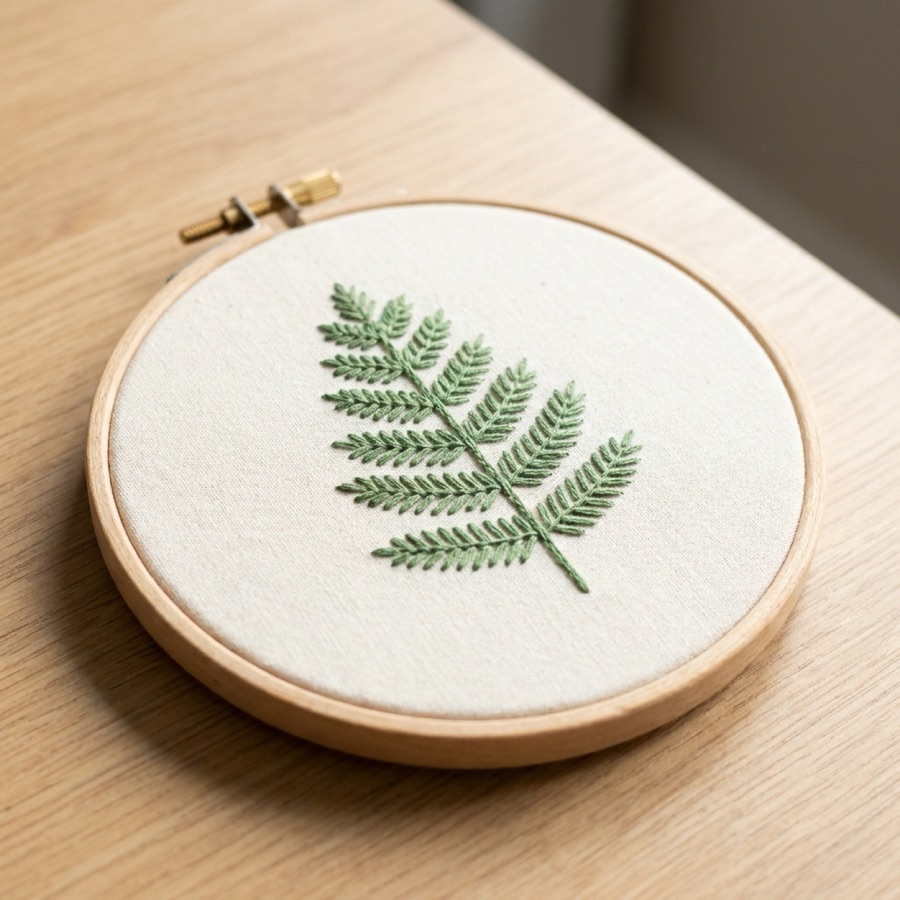
How to do fly stitch, step by step
- Come up at the top left of the V (point 1).
- Go down at the top right (point 2), at the same height, but don't pull tight: leave a loop.
- Come up at the bottom point of the V (point 3), between and below 1 and 2, inside the loop.
- Pull gently until the loop forms a V.
- Go down just below point 3 to tack the V in place. A short tack makes a V; a long tack makes a Y.
Stacked fly stitch for a fern or leaf
- Draw a centre line.
- Start at the tip with a single straight stitch.
- Work fly stitches down the line, each V's arms starting just below the previous V's arms, and each tacking stitch running down the centre line.
- Make the arms longer as you go down for a leaf shape, or keep them even for a fern frond.
The tacking stitches join up into a continuous stem.
Tips
- Mark the arm points with dots along two side lines for even Vs.
- Keep loops snug, not tight; tight loops make narrow, pinched Vs.
- Use 2–3 strands in one or two greens.
- Vary the tack length to change the look: short for leaves, longer for wheat.
Common mistakes
| Problem | Fix |
|---|---|
| V collapses into a line | Come up inside the loop; pull gently |
| Arms uneven | Mark arm points first |
| Stem is broken into dashes | Start each new V right where the last tack ended |
| Leaf shape wobbly | Draw outline and centre line as guides |
Where to use fly stitch
- Ferns and leafy sprigs in botanical embroidery
- Wheat ears and grasses
- Little birds in the sky (single Vs)
- Feathery fills and borders
Similar stitches: fern stitch (three straight stitches from one point), feather stitch (alternating open loops) and fishbone stitch for solid leaves.
Fly stitch is in Hoopie's "Flowers & leaves" stitches with an animated step-by-step guide.
Frequently asked questions
What is fly stitch used for?
Leaves, ferns, wheat, little birds, borders and feathery fills.
What is the difference between a V and a Y fly stitch?
Only the tacking stitch: a tiny tack gives a V, a longer tack gives a Y with a tail.
Is fly stitch good for beginners?
Yes. If you can do a lazy daisy, fly stitch uses the same open-loop idea.
How do I make a fern with fly stitch?
Stack fly stitches down a centre line, starting each new V just below the last, so the tacking stitches form the stem.