How to Fill Shapes in Embroidery: 8 Fill Stitches Compared
Choose the right embroidery fill stitch: satin, long and short, seed, French knots, fishbone, chain, couching and turkey work, with when to use each.
By Ayoub Farid · · 2 min read
Filling a shape is where your design gets colour and texture. The right fill depends on the shape's size, the look you want and how much time you have. Here are eight fill options and when each works best.
Quick comparison
| Fill | Look | Best for | Difficulty |
|---|---|---|---|
| Satin stitch | Smooth, glossy | Small shapes under ~1 cm wide | Medium |
| Long and short | Smooth, blended | Large shapes, shading | Medium–hard |
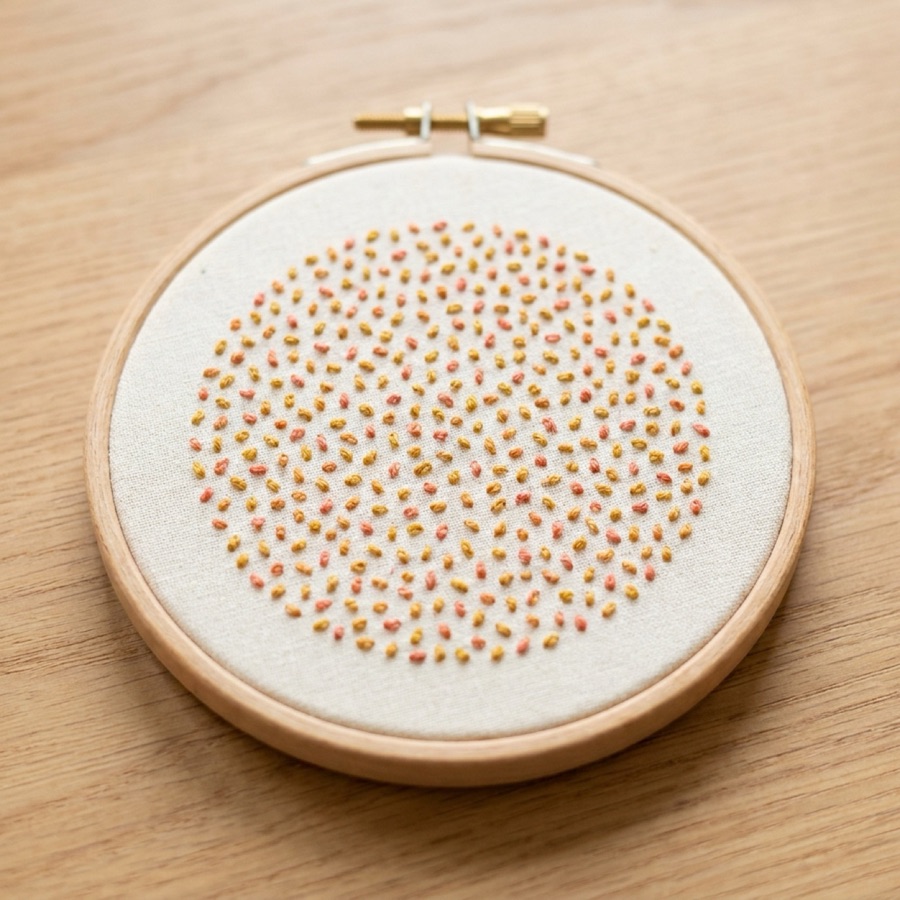
| Seed stitch | Speckled texture | Any size, light fills | Easy |
| French knots | Bumpy, rich | Centres, texture | Medium |
| Fishbone | Leaf with vein | Leaves, petals | Easy–medium |
| Rows of chain or split | Textured lines | Letters, curvy shapes | Easy |
| Trellis couching | Lattice | Large decorative areas | Medium |
| Turkey work | Fluffy | Centres, animals | Medium |
How to choose
Small, smooth shapes
Satin stitch. Outline first. See satin stitch tips.
Large shapes
Long and short stitch, rows of split stitch, or trellis couching. Satin stitch would be too long and loose.
Quick and forgiving
Seed stitch or rows of back stitch. Both hide small irregularities.
Texture
French knots, turkey work or seed stitch.
Leaves
Fishbone or satin stitch at an angle. More in leaf embroidery.
Tips for any fill
- Outline first for a crisp edge.
- Work in the direction the shape "grows" (petals from base to tip).
- Fill edges before the middle for even coverage.
- Use a stabiliser for dense fills on thin fabric to prevent puckering.
- Step back and look from a distance; gaps are easier to spot.
Rows of line stitches as a fill
A simple, modern fill: work rows of back stitch, split stitch or chain stitch side by side, following the shape's outline inward (like a contour map) or in straight parallel rows. Easy to control and looks great on letters.
Practice exercise: a fill sampler
Draw six 2 cm circles on one piece of fabric and fill each with a different stitch: satin, seed, French knots, rows of split stitch, long and short, and fishbone (as a leaf shape). Label them with a pen.
You'll see which fills are quickest for you, which look best in your chosen thread, and how each handles edges. Keep it as a reference when planning new designs.
Frequently asked questions
What is the easiest embroidery fill stitch?
Seed stitch, followed by rows of back stitch or split stitch.
How do I fill a large area in embroidery?
Use long and short stitch, rows of split or chain stitch, or trellis couching, rather than satin stitch.
What is the best fill for leaves?
Fishbone stitch or angled satin stitch.
Why does my fill look patchy?
Stitches are unevenly spaced or the thread is twisted. Work evenly and untwist often.