Embroidery Supplies for Beginners: What You Actually Need
The essential hand embroidery supplies for beginners: hoop, fabric, floss, needles, scissors and pens. What to buy, what sizes, and what to skip at first.
By Ayoub Farid · · 2 min read
Craft shops have walls of embroidery supplies, but a beginner needs very few of them. Here is exactly what to buy to start hand embroidery, what sizes to choose, and what you can safely skip until later.
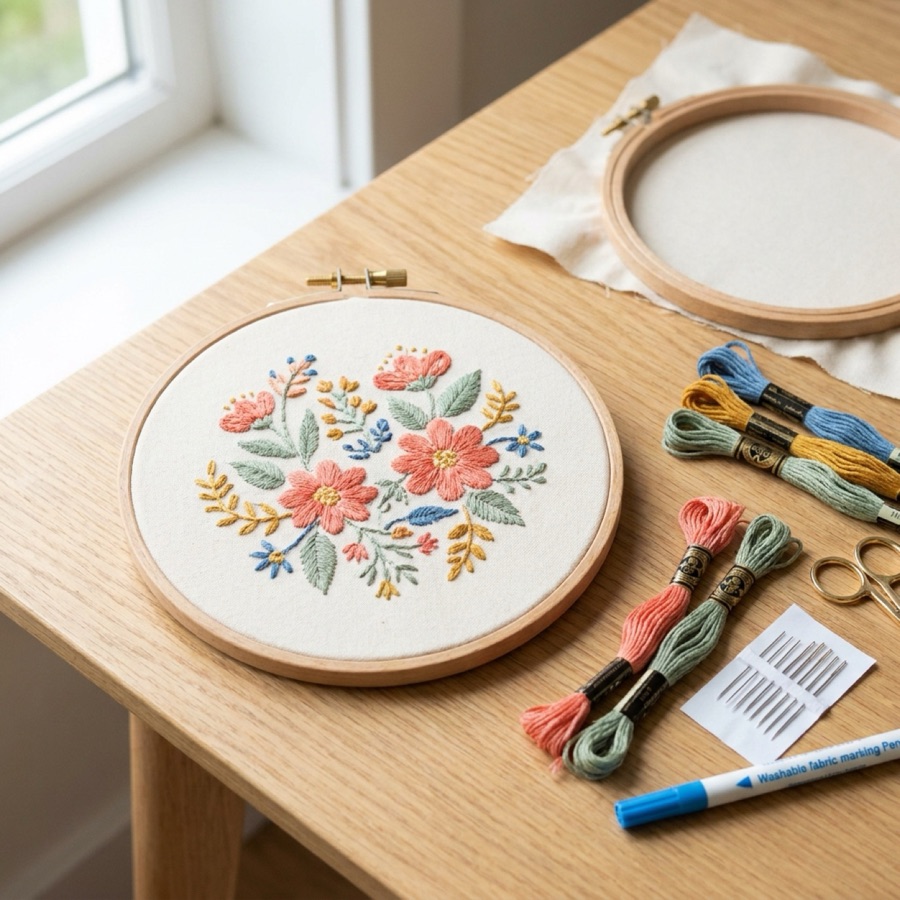
The essentials
1. Embroidery hoop
Holds your fabric tight. Choose a 15–20 cm (6–8 in) wooden or plastic hoop with a screw. Wooden hoops look nice for display; plastic ones grip well. See embroidery hoop sizes and how to use an embroidery hoop.
2. Fabric
Medium-weight woven cotton or linen in a light colour. Quilting cotton, calico/muslin or cotton-linen blends are perfect. Avoid stretchy knits and very thin or very thick fabrics at first. More in best fabric for embroidery.
3. Embroidery floss
Six-strand cotton floss (DMC, Anchor or similar). Start with 5–8 colours you love, plus black or dark grey for outlines. One skein goes a long way. See embroidery floss guide.
4. Needles
Embroidery (crewel) needles, size 5–9 in a mixed pack. A sharp point and a long eye make threading floss easier. See embroidery needles guide.
5. Small sharp scissors
Embroidery scissors (often stork-shaped) cut close to the fabric. Any small sharp scissors work.
6. A way to draw your design
A washable (water-soluble) fabric pen, a heat-erasable pen or a sharp pencil. Test on a scrap first. See how to transfer embroidery patterns.
Nice to have
- Needle threader: helpful if threading is fiddly.
- Thread organiser (bobbins or a box): stops floss tangling.
- Milliner's needles: make French knots and bullion knots easier.
- Thimble: if you push the needle with your fingertip a lot.
- Daylight lamp: for evening stitching.
What to skip at first
- Huge 100+ colour floss sets (you'll use a handful)
- Specialty threads (metallics, silk) until you know the basics
- Embroidery machines (completely different craft)
- Expensive frames and stands
Beginner kits vs buying separately
Kits are convenient and include a pattern, but some include poor-quality floss or fabric that's hard to stitch. Buying separately lets you choose good basics, and you'll reuse the hoop, scissors and needles for years. Either way, a starter setup typically costs $10–25 (how much does embroidery cost to start).
When you start Hoopie, it asks whether you have supplies and, if not, adds this starter list to your plan.
Frequently asked questions
What do I need to start embroidery?
A hoop, plain woven fabric, six-strand embroidery floss, embroidery needles, small scissors and a washable fabric pen.
What size hoop is best for beginners?
15–20 cm (6–8 in). Big enough for a design, small enough to hold comfortably.
Can I use regular sewing thread for embroidery?
You can, but it's thin and hard to see. Embroidery floss is easier and looks much better.
Can I embroider without a hoop?
You can on stiff fabric, but a hoop keeps fabric tight and makes stitches far more even. Beginners should use one.